
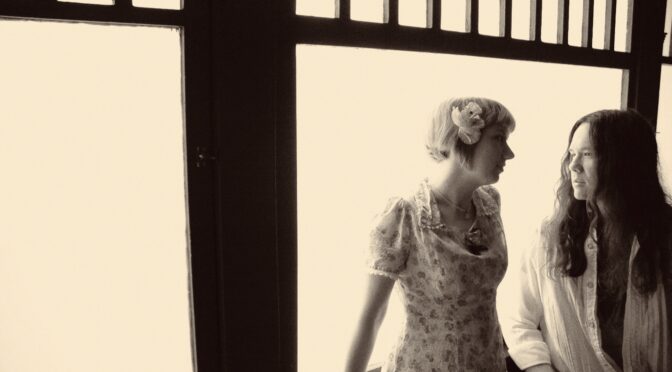
This week’s episode of Unwind with Anji Bee is a half-hour feature on Lovespirals, and its earlier incarnation, Love Spirals Downwards. Band founder, Ryan Lum, joins show hostess and Lovespirals vocalist, Anji Bee, in-studio to discuss the band’s 16 year history during one of the most revolutionary periods in music. From 8 track cassette to digital recording, indie record label success to totally indie self-release, fanzine and college radio to website and podcasts – we talk a bit about all the changes the band has experienced. We also premier a brand new track from our upcoming album!
Tracklisting:
- “Amarillo” Love Spirals Downwards Ever (1996)
- “Love’s Labours Lost” Love Spirals Downwards Idylls (1992)
- “Subsequently” Love Spirals Downwards Ardor (1994)
- “Windblown Kiss” Lovespirals Windblown Kiss (2002)
- “Our Nights” Lovespirals Windblown Kiss (2002)
- “Sandcastles (Podsafe Edit)” Lovespirals Free & Easy (2005)
- “Abide” Lovespirals Free & Easy (2005)
- “Motherless Child” Lovespirals Long Way From Home (Oct. 2007)
- “Unwind Theme Song” Lovespirals Unwind Podcast (2007) Free Mp3
Unwind Lovespirals / Love Spirals Downwards Artist Feature (2007)
[Transcript]
[Anji Bee]: Tonight on Unwind, I present to you a special artist spotlight on Podsafe Music Network artists, Lovespirals and Love Spirals Downwards. As many of you know, I am the singer and lyricist of the band Lovespirals. Actually, we wrote and recorded the theme song for Unwind and I’ve played a few of our songs on the show, including one from before I joined the band, when it was called Love Spirals Downwards. Lovespirals are currently completing our third album, due out later this year. And Love Spirals Downwards are reissuing remastered versions of their first two albums on Projekt Records. So I thought it would be nice to give you a sneak preview of our new music and share a little bit of our musical history with you as well. I’ve got multi-instrumentalist and producer Ryan Lum, the band founder, in the studio with me today.
[Ryan Lum]: Hi, it’s nice to be here, Anji.
[Anji Bee]: Great, as always, to have you here. So for the next half hour, Ryan and I will be playing a selection of tracks from his 16-year recording history and discuss how the band has evolved over that time. So, when did you first start writing and recording your own songs?
[Ryan Lum]: Wow. Um, I don’t want to sound too dated, but I used to have a four-track cassette recorder. I bought that in the late 80s and I was stoked. I finally could, you know, not just jam with people or just play by myself — I could actually get stuff down on tape. So I started with that and after I had a taste of it, I wanted to really do some more serious recording. I wanted an eight-track mixer and tape recorder. So I saved — oh man, it was so much money back then — it was like the best one. I still have it laying around. It’s called a Tascam 388. In fact, I made my first two — three albums— exclusively on that thing. It was like $3,000. I saved, I think, almost half of it and I begged my parents for a loan for the rest, which I kind of still need to repay them back.
[Anji Bee]: Wow.
[Ryan Lum]: But yeah, I got that and I was able to take my productions far beyond what the four-track cassette allowed. So that’s kind of how I got started. Was that the question?
[Anji Bee]: Yeah, I was actually curious how you just started even composing music.
[Ryan Lum]: Well, once you got the tape recorder, you’re going to use it, you know? You’re going to start putting stuff down and creating songs that way. At first they were instrumental —or vocal-less— I didn’t have a singer at the time. Some songs were more intended to be pure instrumental and others would have been awesome if I had a singer to put stuff on top of the song, but that’s how I got started. Just as a fun thing. I always knew I liked to do it. When I was making music with bands before that, I already knew what I wanted to do; I wanted to produce it in a studio. I just didn’t have access to that technology. Now anyone can buy an Apple and have GarageBand built in and pretty much do what I wish I could have done. You don’t have to spend $3,000 beyond the computer that you’re buying. It’s awesome.
[Anji Bee]: That’s so true. The computer isn’t even $3,000 these days.
[Ryan Lum]: No. Like my Mac Mini — a few hundred bucks. Which I don’t make my albums on. That’s like my daily machine for email and all that.
[Anji Bee]: Yeah. Why don’t you talk about how computers have changed the way that you create music?
[Ryan Lum]: Well, originally, they didn’t have anything at all to do with the way I made music. I mean, you made music and then if you’re lucky you had a computer. Well, I had a computer. I just used it to do my college assignments on — you know, like word processing. It wasn’t until when I finished my second album, Ardor, I was in San Francisco, and that was like a technological hotbed —it still is— and I had this friend of a friend who had a four-track hard disk recorder thing, an ancient DigiDesign program. I forgot what it was called, just four tracks. And I was just amazed — like “Wow, you could get all the songs on your computer and you could move the tracks around?” It just blew my mind. So from then on I had this quest. I wanted to get into it. Unfortunately, it took many years before I could actually afford something that I could get my hands on. This stuff was really expensive up until like the late 90s, early 2000s. But finally I got — at first I started off with Cubase and later on I graduated onto Pro Tools, which I’ve been on ever since. It’s totally changed the way I make music. In some sense it hasn’t — I still want to record a nice sound and a performance down on to tape — which I used to do on tape, anyway. But it’s way easier now to cut a piece of phrasing from one solo on this track and copy it and paste it to another phrasing on another track. It just enables me to do what I wanted to do and make it easier. Now it’s tied to the computer for better or worse, but I try to use it for good and not evil. I don’t, you know, fix Anji’s vocals and Auto-Tune it so you’re singing fake and all that stuff. I just use it as a good editor and recorder basically.
[Anji Bee]: Well, having taken recording classes and worked on tape, 24-track machines and ADAT, I know that it’s much simpler to work on a computer as well because you can visually see the audio file in front of you.
[Ryan Lum]: Yeah, it’s cool to see what’s going on. Yeah, to see the music.
[Music plays]
[Anji Bee]: Ryan made his musical debut as Love Spirals Downwards in 1992 on the indie label Projekt Records. The popularity of two songs included on the From Across This Gray Land 3 compilation led to an offer to release a full-length album for the label. So what was it like putting together your very first album?
[Ryan Lum]: It’s cool. It’s cool. I saw it as a fun, cool opportunity. I remember I thought I was almost done when I got that offer and then I just made a few more songs and they all tied together — sound-wise, theme-wise, mood-wise — and we gave it to them and just that was it. It was kind of the right sound for the right time for the right label. If people remember the 4AD sound of the late 80s, early 90s, it was kind of in that vein and there was a demand for bands that kinda made that. There were only a few bands on 4AD and I think we kind of captured that spirit pretty well at the time. I guess because I was listening to that stuff so much back then. I’m guilty! And yeah, it was kind of a minor hit for being on that level of an indie label like Projekt.
[Anji Bee]: From the 1992 album Idols, this is “Love’s Labor’s Lost.”
[Music plays]
[Anji Bee]: So I guess we can’t really talk about Love Spirals Downwards without mentioning the vocalist, Suzanne Perry. How did you guys find each other and start collaborating on music?
[Ryan Lum]: We met at the music conservatory in Paris… No really, we were living in the same hometown and started dating. We met at a job at the local record store, Music Plus, which has long since gone out of business.
[Anji Bee]: I worked there too.
[Ryan Lum]: Wow, you parallel my life. So yeah, she heard some of the stuff I was making back on the aforementioned eight-track and to her surprise she goes, “Oh my god, this is good,” because most people in bands, you hear their stuff and it sounds like crap. You know? Anyway, she was actually surprised — “This is good stuff!” So it just kind of took off from there. I recorded her for a song or two and it all fit in and just kinda clicked. Once we figured out what her voice sounded like and how it fit in, the album came together pretty easily from there. And you might hear from her lyrics — you might ask yourself, “what the hell is she saying?” It’s kind of a make-believe language. You might hear a word or two from English or another language and sometimes we’ll invent a language or invent words and combine it with an English word right after. So the music was kind of made more for contemplation, relaxation, meditation rather than analyzing a story or making you think about a specific something. It’s kind of meant to drift off and float away and take it where your particular mind takes it to.
[Anji Bee]: Well, I must also point out that that’s a fairly 4AD thing to do, considering Cocteau Twins and Dead Can Dance were their biggest sellers and neither of them had real lyrics either.
[Ryan Lum]: I guess so, huh. I don’t know what their reasons were. I mean, yeah, I was obviously influenced by them. But it seemed to work out really well for the kind of dreamy music that I’ve just kind of been making for most of my life. It was a good fit in this case.
[Anji Bee]: We’re just listening to the remastering of “Subsequently” from Love Spirals Downwards’ second album Ardor. So it’s a good time to bring up the reissues that will be coming out later this year. How did that come about?
[Ryan Lum]: Yeah, basically all these songs we’ve been hearing so far — they’re from my first two Love Spirals Downwards albums, Idylls and Ardor. They’ve been out a while and the label ran out of copies. Which is good because inside the credits it’s all wrong information — addresses to contact that are no longer good. So the question was, “What should happen with these albums?” Should I press some up on our label, Chillcuts? But I was talking with Projekt, the original label, and we came to an agreement to do the reissue through them and I’m really happy. It’s all working out wonderfully. Particularly musically — I’ve always been kind of bummed on the mastering of these two albums. I debated how I should go about remastering it. Should I use my friend Robert Rich, who I use for all my mastering? But I leaned toward trying this myself because I’ve heard these albums so many times on so many systems throughout the years. I knew pretty much what was wrong with them sonically and how I could fix them. It was really subtle. I didn’t have to do too much and the end result is these songs sound way sweeter, way cleaner than ever before. I’m really proud of what I did. I’ve learned a lot about audio since 1992 and four. Check it out when it comes out this summer/fall 2007. I’m sure you’ll be able to buy it from lovespirals.com too.
[Anji Bee]: Yeah, I’m actually excited about some of the extra material that’s been dug up and added to the CDs, as well.
[Ryan Lum]: Oh yeah, I forgot about that. In addition to the sweetened-sounding audio, yeah, we dug up extra or just unreleased material. In some cases they were studio songs that just never made it onto the album for one reason or another.
[Anji Bee]: And there’s also that live track.
[Music plays]
[Anji Bee]: You brought up something that I actually wanted to ask you about. You mentioned the outdated information inside your CD covers. When did you create your first website?
[Ryan Lum]: Oh my goodness. I don’t have the clearest memory. Somewhere around when my third album came out, I finally had a website going on for it. So somewhere around ’95, ’96. I think Projekt’s site — I was able to get a directory, a folder to put my first website onto. It’s kind of just taken off from there from those tiny first steps.
[Anji Bee]: Many of the bands that I speak to and interview on my various podcasts credit the internet for the bulk of their musical success. Now obviously your band started before, not the invent of the Internet, but the explosion of the Internet, so I suppose your case is a little bit different. But how have you seen your career change since the Internet has really taken over as a major means of musical distribution?
[Ryan Lum]: Communication, big time. Like back before then — how would people learn about you? There was nowhere to go. There was no building, or something, a book? No! It was kinda hard. Basically, here’s what would happen: people would buy our CD, they’d see the address inside and they’d write to us and we’d write them back, and maybe once in a while send out a little mailing or something, —which can be extremely expensive, actually — especially if you have more than 100 or so fans. Now people have a place they can go to, and early on they were able to sign up via email address and get mailings — which we still do — and now it’s evolved on with us with Lovespirals. We have a pretty regular podcast. Communication has been revolutionizing. They come and read about you, and that was something that was pretty impossible before. They would just hear about you by word of mouth.
[Anji Bee]: That actually segues nicely into how you and I met and began working on music together. Before the internet was commonplace, I was actually doing a fanzine — one of those pieces of paper that you had to pick up and read about Love Spirals Downwards in.
[Ryan Lum]: Yeah, that was yeah, one of those rare ways people found out about us. What was your circulation? Like 20 copies maybe?
[Anji Bee]: No. No, no. I used to press up a thousand. I sold them in stores worldwide. I had Tower distribution. And so, Projekt was one of my advertisers — he paid me money to put ads and he also sent me copies of music to review, yours included. So that’s how I first heard about you. And then later I became a college radio DJ — before the Internet, once again, before there were podcasts — and Projekt was still sending me things to play on the show and setting me up with interviews, such as with you. So I interviewed you a few times at KXLU. And it was actually during a 1998 interview that you started talking about creating a side project outside of your work with Suzanne. And I remember the first time I went into your studio, you played me some audio that ended up becoming the instrumental song “Beatitude,” which was eventually released as Lovespirals. And just a little bit of a song that way down the line ended up becoming “Love Survives.”
[Ryan Lum]: Lovespirals songs you’re talking about now.
[Anji Bee]: I know. That’s on the second album.
[Ryan Lum]: So yeah, basically around then I just basically stopped working with Suzanne. No particular reason — we didn’t have a fight and say, “I hate you, we’ll shant never work together,” or anything like that. You know, it had just kind of run its course and I was ready to move on and try something a bit different. And we started working together, you and I.
[Anji Bee]: Yeah, now this is where it gets hard for me to do the interview. Okay, one more question as an interviewer.
[Ryan Lum]: All right.
[Anji Bee]: This will be interesting for me to hear your answer to. How would you describe the difference between Love Spirals Downwards and Love Spirals?
[Ryan Lum]: Wow. I know it, I hear it. It’s one of those things where it’s harder to articulate. It’s more of a concept, a feeling, a sound rather than something I can say in 20 words. That’s tough. A lot of it has to do with time. That was where I was in the 90s with Love Spirals Downwards, and Lovespirals is where I’m at now — and with Anji, a whole different person, and it’s the result of a collaboration with a whole different person at a different time.
[Anji Bee]: And on that note, why don’t we check out a track from our debut 2002 album Windblown Kiss? This is “Our Nights.”
[Music plays]
[Anji Bee]: So it was slightly awkward transitioning from Love Spirals Downwards to Lovespirals. We had an mp3.com account that combined both bands’ music. The first song to be released to CD was a remix of Claire Voyant’s “Bittersweet” and it actually came out under the name Love Spirals Downwards. The first song released to CD under the shortened name was on a 2001 holiday comp for Projekt — a cover of “Aspen Glow.” But the whole time Ryan was actually using lovespirals.com as his website.
[Ryan Lum]: Yeah.
[Anji Bee]: And in interviews you normally seemed to refer to yourself as Love Spirals.
[Ryan Lum]: I guess it made sense to call the new project, the new band Love Spirals.
[Anji Bee]: Yeah, for me — I mean, we could have been Love Spirals Downwards, but I never liked the connotation of love spiraling downwards. It almost seemed to be like, you know, jinxing something.
[Ryan Lum]: I was over that too.
[Anji Bee]: Yeah, and it’s a lot harder to typeset. I’ve got to tell you.
[Ryan Lum]: Oh yeah.
[Anji Bee]: But yeah, it was interesting segueing from one to the other. I mean, I think you kind of think of it as two separate bands, although a lot of people on the Internet think of it as one band that changed their name — like, I don’t know, there’s a lot of bands like… was it The Amazing Pink Floyd?
[Ryan Lum]: Yeah, then it became The Pink Floyd…
[Anji Bee]: Yeah, and then Pink Floyd. And, oh, Jefferson Airplane.
[Ryan Lum]: Jefferson Starship, Starship.It’s kind of like that, you know. If you’re a band and you exist over time, things change and you might need to change your band name — as opposed to a band that’s been together four months. But if it’s been a little while, things happen.
[Anji Bee]: Speaking of things changing over time — right now we’re listening to “Sandcastles” from our second album Free and Easy, which came out in 2005 on our own label, Chillcuts. One of the interesting things about “Sandcastles” is that we had actually written it originally for the first album, Windblown Kiss.
[Ryan Lum]: Yeah, that’s right. And we just didn’t think it fit on Windblown Kiss that well. In fact, a few songs we wrote, we thought didn’t fit that well. So we saved them for Free and Easy.
[Anji Bee]: And they actually ended up undergoing some fairly dramatic changes.
[Ryan Lum]: Metamorphosizing.
[Anji Bee]: But this was one of the songs that we played on our first tour. In fact, it might be interesting to mention our first show ever was being one of the headlining bands for Projekt Festival in Philadelphia.
[Ryan Lum]: Yeah, they put on — as the name implies — a big show every once in a while. Every few years they’ll do that.
[Anji Bee]: Yeah, so it was sort of interesting for me to make my debut to the Projekt world as the new singer of your band during a huge two-day festival. A little bit of a nail-biter for me.
[Ryan Lum]: Yeah, it’s kind of like doing a free-form jazz odyssey in front of a festival-sized crowd.
[Anji Bee]: Luckily it wasn’t that bad. I mean, I think I did pretty good considering how nervous I was to take the stage with you. I mean, we’re not really the most live-oriented band. We’re definitely more of a studio band.
[Music plays]
[Anji Bee]: You mentioned earlier podcasting as being one of the avenues that Lovespirals uses for promotion.
[Ryan Lum]: And communication. Yes.
[Anji Bee]: Absolutely. Here we are podcasting right now. And it brought to mind the fact that one of the motivating factors for beginning our band podcast, Chillin’ With Lovespirals —
[Ryan Lum]: In 2005.
[Anji Bee]: Yes — was indeed the promotion of our album Free and Easy. So do you remember when I first brought up the idea of us starting a podcast?
[Ryan Lum]: Yeah, being the techno-geek guy, I might have heard of them. So fortunately I could give you an intelligent response as opposed to “What the hell are you talking about, girl?” But um, yeah, at first I thought about it and it seemed to make sense — yeah, why not? But just back then it was tougher — where do you host your audio? Can we afford for people to download the show? How many people would listen? But yeah, it’s all worked out wonderfully. In fact, now it’s our preferred mode of communication. If you write to us to subscribe to our email list, you’ll get a little letter back saying, “Thanks for writing, but check out our podcast. That’s what we update all the time.”
[Anji Bee]: Absolutely. I mean, why read text in an email when you can hear us talking about what we’ve been working on?
[Ryan Lum]: You could do way more in a podcast. We share clips from our upcoming album, we read emails we get — it’s just a much more dynamic way of staying in touch and communicating.
[Anji Bee]: Yeah, not only that, but I think it’s also helped to expand our audience and raise awareness of Lovespirals to people who weren’t already fans. So it’s really kind of a double bonus.
[Ryan Lum]: Yeah.
[Anji Bee]: So we’d been making our own podcast since mid-2005, but we really broke into the Podsafe Music community once my boss, Adam Curry, began the Podsafe Music Network. I remember within days I added some Lovespirals songs and sent him an email asking him to check it out and to my great surprise, he did end up playing us on the Daily Source Code.
[Ryan Lum]: Yeah, I remember.
[Anji Bee]: Yeah, I was pretty excited. So I mean, it’s kind of complicated, but I guess that’s what was really the impetus for me to get even more involved with podcasting — not only getting our music out to other podcasters, but into starting my own music podcast for Podshow. And it led to me being here today doing Unwind. And yeah, I really cannot encourage bands enough to make some of their music available to podcasters and to get involved with the music podcasting community, because it’s a really good experience for independent bands particularly — but even signed bands, there’s always new people to be reached through podcasting. So let’s check out a little bit of one of the tracks that Adam actually played on one of the Daily Source Codes. It’s called “Abide” and it comes from our self-released 2005 album, Free and Easy.
[Music plays]
[Anji Bee]: So Lovespirals are currently wrapping up the creation of our third album.
[Ryan Lum]: Still untitled.
[Anji Bee]: And as we mentioned, we have been playing bits and pieces of songs on Chillin’ With Lovespirals over at lovespirals.com. But I thought that I would give you Unwind listeners a very special sneak peek of an entire track from our upcoming album, which should be released —
[Ryan Lum]: October of this year, 2007.
[Anji Bee]: Yeah, I mean we’re already scheduling the mastering and photo shoots, so it is imminent. You can’t hear this track currently anywhere else. This is our version of “Motherless Child,” which is an anonymous song and it’s been done by many people in many forms. But this is Lovespirals’ take on the song. So without further ado, the special Unwind premiere of “Motherless Child.”
[Music plays]
[Ryan Lum]: Well, it’s been fun being on Unwind with you, Anji.
[Anji Bee]: Yeah, a little bit different than Chillin’ With Lovespirals.
[Ryan Lum]: Speaking of which, you can subscribe to our podcast at lovespirals.com. And also while you’re there, help us out by buying one of our CDs — or both of them — and we’ll autograph them for you too.
[Anji Bee]: Yeah, and we’re including a signed poster while supplies last as well, over at lovespirals.com. Keep your eyes peeled for more information on our album, which I think is going to be called Long Way From Home. And once again — when are the Love Spirals Downwards reissues coming out?
[Ryan Lum]: This summer. I think July, August 2007.
[Anji Bee]: I’m sure we’ll be talking more about that on our podcast and sites. So stay tuned for more from us, Lovespirals. As always, I want to thank my sponsors Tylenol PM for making this show possible. You can find out much more about Tylenol PM at tylenolpm.com where you can also find a coupon for $1 off your next order. Well, it’s been a pleasure once again producing Unwind for you. You can find out more about the show at unwind.podshow.com. Leave a comment or review — I appreciate it, appreciate all of your support. And you can find out more about the Podsafe Music Network, of which Lovespirals are a part, at music.podshow.com. I’m your hostess Anji Bee of Lovespirals, wishing you a good night.
[Closing promo]
[Anji Bee]: Join vocalist Anji Bee and musician Ryan Lum for a behind-the-scenes look into an indie band on Chillin’ With Lovespirals.
[Ryan Lum]: Ever wonder how an indie band operates?
[Anji Bee]: From writing and recording to releasing and promoting, to live performance and song licensing.
[Ryan Lum]: And how the internet, computers, and modern technology play a growing role in all of this.
[Anji BeeB]: Chillin’ With Lovespirals covers it all.
[Ryan Lum]: Listen — or better yet, subscribe — at lovespirals.com.
[Anji Bee]: See you there.