
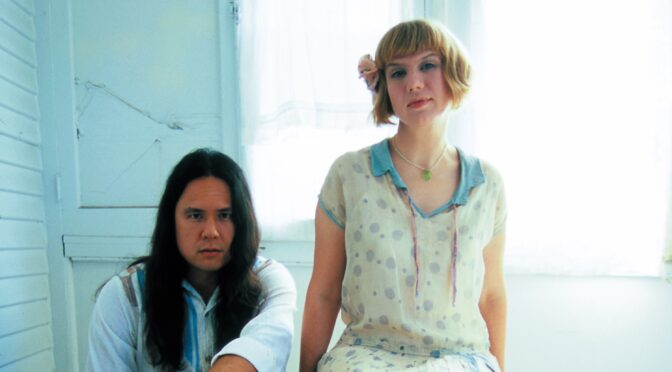
In this extended podcast episode, Anji and Ryan play each song from their new album Long Way From Home as they discuss how the album was created. In this special behind-the-scenes podcast, the duo talk about the album’s influences, song writing, production secrets, and personal anecdotes. This feature gives you great peek into the album!
 Podcast Links:
- Download the Lovespirals: Long Way From Home Feature promo
- Download the Long Way From Home CD promo
- Buy a jewel case CD or digital download of Lovespirals’ Long Way From Home on Bandcamp
Podcast Transcript:
Chillin’ with Lovespirals Long Way From Home Feature November 30, 2007
Anji: Hey, this is Anji.
Ryan: And this is Ryan.
Anji: Of Lovespirals. And we’re just here to talk about our new album, ‘Long Way From Home.’ So, ‘Long Way From Home’ was just released October 23rd, 2007, and it’s the second album that we have released on our own label, Chillcuts.
Ryan: It’s our third album total, as Lovespirals.
Anji: But it’s your… what album is it for you?
Ryan: I prefer not to count that high.
Anji: Seventh or eighth?
Ryan: So let’s just kind of leave it as our third Lovespirals album.
Anji: (Giggles) This is the first album that we have worked with Reap and Sow, a digital distribution company.
Ryan: They got us onto iTunes and Amazon.
Anji: iTunes plus.
Ryan: Yeah and both those mentioned services that we just said there, you can download the songs as 256k MP3s– which is twice as good as what you normally purchase, and there’s no digital rights management.
Anji: Which is pretty cool. We’re on the cutting edge!
Ryan: Yeah, you can play them on all your computers and MP3 players. So let’s launch right into it with our the first song “Caught in the Groove,” which is actually the first song that we made as we began recording ‘Long Way From Home.’ This is the first song we started.
Anji: Yeah, the first written song and the first one on the album. Makes a lot of sense.
Ryan: Yeah.
Anji: And actually, the first album that we did together, the first song on that was called “Oh So Long” on ‘Windblown Kiss’ and that was the first song that we had recorded for that album.
Ryan: So maybe there’s like a trend. We like to just like set a mood or start something with the first song. And we started this about a month after we got done releasing ‘Free and Easy’ in 2005. That came out in November and in December of 2005 I guess we were restless. We were ready to start making some new, different music that really kind of took more of the influences that we’d been really listening to for the past two, three, four-plus years. I don’t think ‘Free and Easy’ captured that as much, necessarily. So I think this album was something that was just kind of like, just bursting to come out– at least for me, musically. I was just, you know, I was just primed to make this kind of this stuff and the songs were pretty effortless. They all came out one after another pretty nicely.
Anji: Yeah, this was this was our most fun album to make in a way.
Ryan: Yeah, it’s the first one we really made as an album. Our first few albums are kind of like pieced and patched together with songs recorded in different times and things. This one we recorded like I used to make albums before; one song after another, after another, and they’re all kind of connected. There’s a flow and a feel that drives through them all. And yeah, I’m really proud that how this one came out. I’ve said before, and I’ll say it again, I think this is my best record ever and I’ve, you know, made a few.
Anji: How many? He will not say. You know, as I’m sitting here listening to this song right now, I see this song is so appropriate for what you’re talking about, like the lyrics. I’m saying “only so many ways one can play that same old damn song.” That is kind of how you feel after an album’s over. You’re just like… you’ve done a bunch of gigs and you’ve played the song and you’re just kind of sick of it, you want to write a new song. I feel like that right now actually.
Ryan: We will start soon.
Anji: But it’s great to know we were definitely not caught in a groove after ‘Free and Easy.’ As we’ve shown, all three of our albums have all been fairly different from one another, and this album is definitely no exception. It’s quite a bit different from ‘Free and Easy.’
Ryan: Yeah, if you have ‘Free and Easy’ you might remember it being sort of maybe an electronica sort of downtempo or whatever record and as you can hear so far here with “Caught in the Groove”– no, it’s got more of a poppy bluesy Americana kind of sad melancholic vibe to it.
Anji: The rest of the album goes in similar directions. Definitely some different styles but everything’s kind of got this similarity with the blues, folk, less jazz but…
Ryan: Yeah, speaking of the blues and folk now here’s a very acoustic track, no drums or anything. It’s the second track it’s called “Empty Universe” and I believe, strangely enough, this was the second song as well.
Anji: What do you know, it was the second song.
Ryan: We did this right after “Caught in the Groove.”
Anji: Fairly soon after, as far as I can remember.
Ryan: The album does not progress this way, but… just an interesting fact here.
Anji: It’s just, you know, I think I had kind of gotten used to hearing the two together because, as you’re working on an album you can’t help but listen to the songs when they’re done. You check it out, you think, “Have I fully developed this idea as much as I wanted to?” And with “Caught in the Groove,” actually we went back in towards the very end of the album process and we redid some parts.
Ryan: But, yeah, these two songs work together wonderfully and it’s cool to take this and like put it in perspective; this is the second song and the album’s still kind of sonically and emotionally still kind of being defined. So to go from “Caught in the Groove” into this one it’s starting to expand the palette of emotions and sounds. And you can hear, you know, this is going to be a pretty deep record. It’s not going to be some light puffy stuff.
Anji: Yeah, I think we knew by the time these two songs were done there would be no house songs on this record. It would be too much of a stretch to go from this to something that’s like “Just Trouble,” or whatever.
Ryan: Nah, instead, as you can hear here, I’ve gotten more of my blues guitar going on this record than any other. I mean, I did it in all my records basically, little blues licks or solos here and there, but this album I just let it all go.
Anji: I remember when– this was one of those things where you were just playing guitar privately for yourself, and I always was listening to you because I love to listen to him play guitar. And I was like, “Wow that thing you’re doing is really cool!” And I wanted to sing to it but it was just so unique from anything that you and I had done together. And it was the kind of music that– I mean it was sort like the kind of music you were trying to do earlier in your career, but it’s so different at the same time. You know?
Ryan: Yeah, this is way more loose and flowing and not as tight.
Anji: And I seem to remember that this was one of the quickest songs that we created on the album from like conception to recording, and the recording process was really short. It was just like really quick and satisfying.
Ryan: This next song, the third one, “Treading the Water,” it was not the third song that we made.
Anji: No, not at all.
Ryan: It’s the third song on the album but it was one of the last, if not the last.
Anji: I think it was one of the last ones.
Ryan: It was right in there.
Anji: It could be the very last one before we redid some of the “Caught in the Groove.” Yeah, this song has a lot of good memories for me.
Ryan: Yeah, all the slide guitar and harmonica. It’s hitting that Americana vibe that we were talking about like in “Caught in the Groove.”
Anji: Yeah, hardcore. The thing what’s funny though is that these lyrics I actually wrote them back when we were doing “Windblown Kiss,” surprisingly. There were two songs on “Windblown Kiss” that were co-written by Sean Bowley, an Australian singer songwriter that Ryan knew through his old label project.
Ryan: His band Eden.
Anji: Yeah. And we had a whole EP or maybe even a full album of material that you had started with Sean that I was listening to and we were kind of picking a few tracks to include on ‘Windblown Kiss,’ and so I came up with these lyrics for one of Sean’s songs but we didn’t do it. And, I don’t know, I guess you must have been playing music one day and somehow I thought, “Hey the ‘Treading the Water’ lyrics could kind of go with that.”
Ryan: Yeah, it works well with the music here. Like it’s got the stuff I was talking about earlier, the feel it has, but it also has this Mojave 3 shoegazer kind of vibe. That’s something that kind of surprised me about this record, because I was going heavily into a kind of terrain we haven’t covered like blues, Americana– kind of revolutionary, for me at least, and yet it ties in back to my past with my dream pop roots too.
Anji: Yeah, it’s really kinda weird.
Ryan: It was not something I consciously anticipated, the music going to– but it all works. It’s just music. All the influences tie together and it just works.
Anji: I can’t find one genre that I could just definitively say, “This album is this genre,” because there’s so many different types of music fans that this album might appeal to. I mean, for instance Sam of Projekt Records, he really liked this album quite a bit and the genres that he is marketing to are gothic, dark wave, ambient and definitely fans of that music can relate to this album. But at the same time people that like blues and folk and rock music like it too. And to my surprise even our fans that were more into the downtempo and new jazz thing they’re enjoying it, as well. So we are just straddling all kinds of genre lines here and there’s no way that we can jump on to any one bandwagon. It’s just impossible.
Ryan: Yeah. I guess it’s because I’ve always been of the opinion that I just make music. You know other people, whoever they might be in the chain like distributors or end consumers or whatever, people can categorize it all they want but for me I’m just making music. Some people make music, like, “I’m making psychotrance,” or whatever.
Anji: “I’m a trip hop band.”
Ryan: Exactly. And I just make music and I borrow and steal from all sorts of genres or influences but I’m never trying to be any one kind of thing.
Anji: I know you’re so difficult to work with that way from a marketing perspective.
Ryan: I’m sorry but as long as the music is happening, I’m happy with it.
Anji: Oh now this song, this one’s really fun to play live. This song I think is the one that reminds me the most of a thread that goes through Lovespirals work, the slow burning torchy blues like our first song, “Oh So Long,” and like “Walk Away.”
Ryan: Yeah the slow, minor key, sad stuff. I think this is by far the best of all those.
Anji: Oh I agree, too.
Ryan: Yeah, I mean, it’s fitting that on our most bluesy album our slow, minor key, blues song is the best of those types. And speaking of how I just make music, I don’t try to be a genre, this one –if anything– I was really going for all that stuff Anji was just talking about, as far as a blues torch song, minor key beauty.
Anji: It’s really sexy. This song is so fun to do live. I really enjoy singing it. We even did the acoustic version recently for Second Life and that was fun and sounded pretty good.
Ryan: Yeah this one has one of my favorite or my most proud guitar solos of mine, too.
Anji: I like this vocal coming up too. Like a female Eagles. I guess I haven’t been talking about the lyrics too much. A little bit here and there.
Ryan: A lot of the songs, if you’re into this kind of thing, there’s like a Buddhist undercurrent through many of the songs.
Anji: Yeah, wow. This album is really heavy. It makes me really emotional, like I noticed that when we did the performance for Second Life I just felt like, “Oh thank God I’m all alone in my safe space here in the studio,” because I just felt so vulnerable. My lyrics are becoming even more personal than they ever… I feel like I’m more able to express myself now, and the kinds of things that I’m dealing with on an emotional level right now: we’re getting older and you just question –I mean, I’ve always questioned the nature of reality and…
Ryan: Time and change.
Anji: Time and change.
Ryan: That’s what Buddhism’s kind of all about.
Anji: Impermanence. There you go. It’s like you have these moments of lucidity in life where you kind of see your place in life. You just kind of experience the oneness of you and the universe and everything around you and you feel alive. But most of the time you’re just caught in the day-to-day drudge of it all and you’re just numbed to all that. When you have one of those moments it’s so precious and I kind of feel like when we make music it kind of is one of those moments. It really is. It balances and centers me and puts me where I feel like I can really understand life.
Ryan: I love making songs. It’s just so great.
Anji: So do I. I can’t wait to make another album.
Ryan: That’s why we’re a studio band. We just love making these creations, these little musical babies, in the studio.
Anji: Yeah. Okay so here we are, we’re at the second single. It is so hard to select singles, by the way. I know in your career you never really had to worry about singles before.
Ryan: Yeah, not much.
Anji: But with the podcast-safe music movement it kind of brings us closer to the standard top 40 artist way, in that they have to select what to release into the world.
Ryan: It really means a single song that you have to choose from your many to promote and show the world.
Anji: Yeah and represent what you’re up to.
Ryan: So this is the first of the singles that we chose, right?
Anji: It’s the second. The first single is going to come up next, “Motherless Child.”
Ryan: Okay, yeah, you’re right. This one is called “This Truth,” and this was a later song. This may have been the last song, I’m not sure.
Anji: Yeah that’s true. I remember you were kind of like, “Hey look, I’m writing you a Rhodes song!”
Ryan: Yeah it’s kind of strange, like we were realizing we should have one song that’s not quite as sad and down, not to sell out or anything, but just something a little more upbeat, sort of.
Anji: Uplifting. Yeah absolutely.
Ryan: I was jamming on the Rhodes –or at least the road sampler– and I started jamming this, you started humming and it all started from there.
Anji: I remember I was pretty stoked you came up with this. I said, “Now here’s a song I can play on the Chillcast!”
Ryan: Your podcast. Yeah all the others would have been a little tougher.
Anji: Back to the marketing again, here. Really, a good album should have highs and lows, and a few uptempo things to offset some of the slower bits and it just makes it more exciting because you’ll see as you go through the album dynamically. This is probably the most upbeat and then right after comes this gut bucket song, you’ll hear in a second but this song makes me really happy. The lyrics came off the top of my head to go with the music and there’s always something kind of magical about that. Being able to lyrically express what the music is saying.
Ryan: I like these harmonies. They’re sweet.
Anji: Thanks.
Ryan: It’s all clicking here — guitars, voices, keyboards, the roads doing their 70s roads thing.
Anji: I’m getting my Carly Simon on. (Laughs)
Ryan: And all good 70s type songs must end with a nice fade out like that.
Anji: We are big fans of the fade out.
Ryan: Here we are to “Motherless Child,” our first single.
Anji: And see how it makes it seem even more sad after you’ve heard an upbeat song? You’re like, “Oh wow.”
Ryan: That’s the way to do it, guys, if you’re planning out your album try to make sure the flow is good and have contrast.
Anji: Gee, I had no idea we were going to have so much to say.
Ryan: Oh yeah. Getting us to talk about our music I don’t think that’s too arm-twisting.
Anji: Oh you’re right. So we had to do this ourselves because other podcasters would be like, “Okay we got to wrap this up.” (Laughs)
Ryan: Yeah some of you might be going, “Hey, ‘Motherless Child’?” is that song that you may have heard before. You know it’s been done and covered by countless artists over time.
Anji: It has. I didn’t realize it but John Legend had done it fairly recently.
Ryan: Yeah, see?
Anji: We didn’t do it because of John Legend.
Ryan: If anything we were thinking of Woodstock.
Anji: I’m so not thinking of that though. Honestly the first time I remember hearing “Motherless Child” — and I may have said this on the podcast before– it was from Martin Gore.
Ryan: From Depeche Mode.
Anji: I had his ‘Counterfeit EP’ from when I was around, I dunno, junior high school? It was my favorite song and I didn’t realize it was because it was a classic.
Ryan: Yeah that’s what we were looking to do here. We were trying to find a classic song, preferably an old American bluesy number, that we could redo in our own way.
Anji: Ryan really wanted to do “Summertime,” but millions of people had done “Summertime.”
Ryan: As well, but this is pretty much like “Summertime.” It comes from the same era.
Anji: Well what happened is Gershwin, who wrote “Summertime,” was inspired by this song, which is anonymous. Nobody’s really sure who started it, but it’s an old spiritual song and probably people have added and subtracted to it over time. But there’s the quintessential verse and chorus, and people have added other things to it, but I just kind of present the bare minimum verse and chorus version.
Ryan: Yeah but it’s one of our favorites.
Anji: And that’s the name of the album, right there. (End of song plays with Anji singing, “A long, long way from my home.”)
Ryan: Yeah, we got it from that, too. So a very important song.
Anji: Very important to the album. I don’t remember anymore at what point in the process we did that. Maybe about midway.
Ryan: Yeah, midway.
Anji: Now here’s where we really get into the dream pop territory. This is serious ethereal music on this one.
Ryan: This song is called “Sundrenched.” Even the title itself is kind of dream pop.
Anji: Pretty shoegazery. And I have a confession to make. When I originally came up with the lyrics, I was like, “Oh I totally want to do a shoegazer song with Ryan!” I tried to get Ryan interested in the idea, but he was like, “I just don’t write songs like that. I just don’t hear lyrics and then think of music. I write music and then you –or whoever–come up with the vocals to go with it.” And I was like, “Argh!” You know? I was all upset about it. I almost did this song with Bitstream Dream. Rom sent me some music, and I actually recorded myself doing these lyrics to it, and I thought, “You know what? I just can’t do it. I gotta save these lyrics for a Lovespirals song.” One day you came up with music that went with the shoegazer lyrics and it turned out awesome.
Ryan: Yeah it turned out to be one of the most unique and nicest songs on the record, too.
Anji: Now tell, me: what shoegazer, ethereal, dream pop bands play blues licks? I can’t think of any!
Ryan: I can’t think of too many. They might try to dabble on one here or there, but our album is filled with them.
Anji: Like as much as Mojave 3 says they’re all into Americana sound and stuff, I can’t really think of any traditional blues.
Ryan: Just little dabbles here and there. I mean, I’ve been playing blues since I started guitar, which is 20 odd years. I just didn’t always play blues on my records and stuff.
Anji: The only one I can really think of is “Subsequently,” you rip a couple of Jerry Garcia-esque blues licks.
Ryan: Which was on Love Spirals Downwards’ ‘Ardor’ album, yeah. But, it’s not like something I just picked up out of the blue here, this is something that I’ve been doing on and off for most of my life, basically.
Anji: Well, it’s unfortunate that through most of your career, the blues were looked at as kinda not cool.
Ryan: Who knows?
Anji: Don’t you think? Because in the seventies it was super cool and then in the eighties it was all of a sudden not cool to do blues rock anymore.
Ryan: Yeah, it’s come back around. I think now is a really good time for blues. That’s not why I’m doing it.
Anji: Not at all.
Ryan: I love this whole ending here (on “Sun-drenched”), it has a nice 70s vibe.
Anji: You got a great sound.
Ryan: Made shoegazer and 70s kind of one here.
Anji: You know what’s weird, though? I was reading, recently lots of bands are finally giving the 70s their props. I’m so glad that people are realizing that the seventies weren’t just disco music. This is an interesting song (“Nocturnal Daze”)
Ryan: Yeah, this is kinda similar to the second song of the album, a little bit, “Empty Universe.”
Anji: This was one of the really early ones.
Ryan: This song is called “Nocturnal Daze.”
Anji: This is another one of those lyrics that I had come up with at work and just had them tucked away.
I do, literally, have a lyric book. I don’t carry it around with me everywhere, but when I do get an idea I think is good and I wanna keep it, I’ll write it into this lyric book so when I hear Ryan jamming some stuff I can get out my book, flip through it, and see what goes with it. Now sometimes I’ll immediately know that one of my lyrics goes with what he’s doing, but other times I’ll search. This may have been one of the times I searched through it, I’m not sure.
Ryan: I remember we wrote the song in late summer, early fall. I remember surfing one morning, and sitting out in between waves, and this song was going in my head for most of the trip. It was a beautiful day, too, nice sunny day and hardly anyone out where I was. It’s kind of a mesmerizing little song.
Anji: I remember when you were working on it, you were like, “I don’t know what kind of drums I should do, I’m not hearing it.” And I was like, “Eh! Who says we need drums? Just do without drums.”
Ryan: This is kind of an interesting tidbit. I recorded this song without a metronome or timecode, which forced me to never add drums to it later. There’s a decent chance that if I could’ve added drums to the production later, I would’ve added drums in. So I kinda forced myself down this path of not having them. But now I’m glad I did. Sometimes it’s good to not have infinite options when recording. It’s kinda good to have limitations force you into certain directions, and you have to deal with those situations as best you can. In fact, that’s how my old Love Spirals Downwards albums were: dealing with eight track limitations.
Anji: Oh wow, that’s severe limitations compared to these days.
Ryan: Now, having ProTools and digital recording, it’s so much easier to do things than it was before, and you just have more tracks than you had before, so that makes it easier to do things.
Anji: Yeah, like all these vocals you’re hearing right now (in “Nocturnal Daze”), we didn’t have to worry about if there’s enough tracks to do there or four vocals if I wanted to.
Ryan: Yeah. I mean, I always have at least 24 tracks of audio. Back in the day that would have cost 30 to 50 thousand bucks, or whatever!
Anji: You know I have no idea what genre would you call this song. But it strangely does kind of have a Western Americana sound, I don’t know why. Is it the guitar?
Ryan: It’s the blues undercurrent that the piano and the guitar have.
Anji: The funny thing is, if you were to add a drum beat to this song, you could totally make it sound like Zero 7, or — who are those guys? Dirty Vegas, or something?
Ryan: Yeah, it could have been a little bit more of an electronica song, so that’s why I said I’m kinda glad I didn’t have that option left for me.
Anji: That’s a trippy song. Oh, talk about trippy songs! (Laughs)
Ryan: This next one is the second to last song, the ninth song, it’s called “Lovelight.”
Anji: This one is getting super Buddhist, too.
Ryan: Yeah, very Buddhist lyrics here.
Anji: I love the beginning.
Ryan: It starts off with this a capella and guitar beginning.
Anji: Let me ask you something. I remember this song was kinda trippy to write, like we were working on it in bits and pieces, and we weren’t exactly sure how it was all going to come together. I feel like we recorded the intro at a different point, like this was the song (first verse of “Lovelight” playing), but we were like, “This song needs something to start it off.”
Ryan: I don’t remember. I don’t know, it’s possible. Those chords in the intro are a very important part of the song. I think I always just liked playing those chords on the guitar; I still like to play that bit on the guitar when I practice.
Anji: I’m always trying to get him to write intros to songs, I don’t know why. I think because when I was growing up, all these seventies songs have multiple parts and stuff.
Ryan: Pink Floyd.
Anji: Pink Floyd, exactly. Led Zeppelin… Even Grateful Dead, who I didn’t even think about it, but they have a song called “Love Light.”
Ryan: Yeah, mm hmm.
Anji: But I really wanted to write a cool intro on this song, and you kept trying different things, and I was like, “Oh my god, yes, that, THAT!” And after we played it, we were like, “OH! That part is so good!” If you were to listen to the 30 second samples on Amazon you wouldn’t probably think it was just another one of our ethereal songs, but then, “BOOM!” (Laughs) This song could be more upbeat than “This Truth.”
Ryan: Probably the second most upbeat song, if not the most. Cool to have it kinda come at the end, because the previous songs before that, with “Sundrenched” and “Nocturnal Daze,” we kinda groove you in this lull.
Anji: Very low key, dreamy…
Ryan: We pretty much put you on a cloud and float you to this pleasant place, you know? And this song kinda brings you back a little bit. We don’t want you to fall asleep.
Anji: That’s true. We want you to be ready for the last song, which is our favorite song on the album.
Ryan: Yeah, we’ll get to that in a few seconds here.
Anji: (referring to “Lovelight”) Probably the most obviously 70s song?
Ryan: Yeah, it’s the most straight forward seventies rock kinda song. We haven’t really talked too much about that, but that’s a huge influence.
Anji: We like 70s rock. We’ve mentioned a lot of 70s rock bands, here and there.
Ryan: That’s true, you might infer that already.
Anji: Definitely we’ve been listening to a lot of Jerry Garcia and Grateful Dead.
Ryan: Bread, Fleetwood Mac.
Anji: Fleetwood Mac; we got a couple of their albums last year.
Ryan: Pink Floyd.
Anji: Pink Floyd, the new David Gilmour album.
Ryan: Now we come to the last song, “Lazy Love Days.” Which is Anji’s favorite, my favorite, and a lot of other people said it’s their favorite, too.
Anji: Robert Rich said it’s his favorite.
Ryan: I think this is it, if you get the album, it’s for this song. Not to say the other songs are something to disregard.
Anji: It’s weird, you would think this would be the single?
Ryan: It’s not a single.
Anji: I don’t think it would grab just your average listener. If you’re a Lovespirals fan, you’re gonna be like, “Oh my god!”
Ryan: It’s like, “Stairway to Heaven,” is that really a single or not? I don’t know. I guess it kinda was, but it really shouldn’t have been. But I dunno. [note: it was never released as a single in the USA, despite it becoming one of the most requested songs on FM radio]
Anji: We’re already getting choked up just hearing the first couple of chords. This song was an incredible experience to write. It’s one of those moments that we mentioned earlier where you’re just like, “Ahhhh!”
Ryan: It all flowed. It came together quite nicely and easily, not too many struggles. It was actually one of the quicker songs we made, too, strangely. Sometimes songs can go on for months. This one went on for a week or two maybe?
Anji: It was just fun. It grew out of experimenting with a new piece of gear, like just, “Oh let’s see what happens!” And then Ryan just played a couple chords, and it was amazing.
Ryan: We gotta check out the bass solo here. Not too many albums have bass solos anymore.
Anji: (laughs indulgently)
Ryan: I’m just really proud of that bass solo.
Anji: No, I love it!
Ryan: It came out wonderful, as good as any guitar solo on this record.
Anji: It was great. You got that fat, round, smooth Phil Lesh kinda sound.
Ryan: Yeah.
Anji: What’s funny is how simultaneously there’s these classic rock elements and yet super, super dream pop, ethereal whatever…
Ryan: Yeah, we did it again, with this song too.
Anji: Like the perfect blend of Cocteau Twins and Pink Floyd.
Ryan: Well, it makes sense those two band’s sounds would mix, you know, they’re both so ethereal, and they both have that beautiful sadness that you and I love in music.
Anji: Yeah.
Ryan: And now is when the song starts subtly building up to the climactic end.
Anji: I love this part.
Ryan: I like how your simple harmony totally does it, just two voices.
Anji: This has got to be the longest Ryan Lum solo known to man.
Ryan: It is. What a way to close an album, with a two minute solo.
Anji: (laughing) I know. I love that. By the way, I’m so happy that Ryan got a new guitar for this album. This is the first album recorded with this particular Fender and it’s got such a different sound from the guitar that you used on pretty much all your other recordings.
Ryan: Yeah, it’s a beautiful guitar.
Anji: There’s a lot of new gear on this album, actually.
Ryan: The distortion box, the amps; we got some vintage 60s amps and speakers for this.
Anji: Yeah, the amps were a huge part of the sound of this album.
Ryan: A lot of retro stuff going on.
Anji: I think all the retro gear definitely lending to us wanting to exploit it to make a more retro sounding album.
Ryan: Every time I heard this song (“Lazy Love Days”) –I don’t care, I could hear it a hundred times– I love it!
Anji: I love it, too. And I’m surprised I actually like the way it sounds when we play it stripped down live, it still sounds pretty cool.
Ryan: It still comes through.
Anji: Even though it’s such a lush production, stripped down to the bare essence it seems to get that same emotion across.
Ryan: Well I hope you’re enjoyed it as much as we have. ‘Cause we’re pretty stoked right now. And we’ve heard these songs for a long time, you know, many times.
Anji: (giggles) Should we share one of the remixes, just to cap it all off? Maybe your remix of “Motherless Child”? So, f you’d like to hear this album without us talking over the whole darned thing…
Ryan: Meaning you’d like to own it and get your own copy of the CD, there’s only one place where you can get it autographed by Anji and me, and that’s lovespirals.com
Anji: When you buy the CD directly through us, we also give you a special gift; a 6 song remix EP of “Motherless Child” with remixes by our friends Karmacoda, Hungry Lucy, MoShang, our friend Drew the Black Channel Citizen, and Chris Caulder of Beauty’s Confusion.
Ryan: It’s a free download that you get immediately after purchasing the CD, so you get some stuff immediately.
Anji: And we’re really quick to mail out orders, too. So please do that. And while you’re there you can check out all the other stuff we got going on, of course our podcast Chillin’ with Lovespirals, and there’s reviews of the album, lots of pictures, and lots of fun stuff on lovespirals.com. I’m trying to keep that thing updated as much as humanly possible.
Ryan: Yeah, it’s not a site that just gets left unattended. We’re attending to it all the time, so please come by and check it out. Subscribe to our RSS feed, if you know what that is.
Anji: So we’ll see you next time on your normally scheduled Chillin’ with Lovespirals.